Excellent quality and fast dispatch
Products arrived well-packaged with COA documentation included. Really appreciate the clear research-only labelling — exactly what I needed for my lab work.
James R.
Sydney, AU

Triple GLP-1 / GIP / Glucagon Agonist
Everything researchers need to know about Retatrutide peptide — mechanism, published dosing protocols, side effect profiles, reconstitution, and how to source third-party tested Retatrutide in Australia.
Quick facts
Products arrived well-packaged with COA documentation included. Really appreciate the clear research-only labelling — exactly what I needed for my lab work.
James R.
Sydney, AU
Ordered three times now. HPLC verification results have been consistent each time. The pathway browsing structure makes it much easier to compare compounds.
Sarah K.
Melbourne, AU
Same-day dispatch on my last two orders. The batch COA was easy to locate and the product information pages are genuinely useful for research planning.
Michael T.
Brisbane, AU
Representative of verified researcher feedback.
Overview
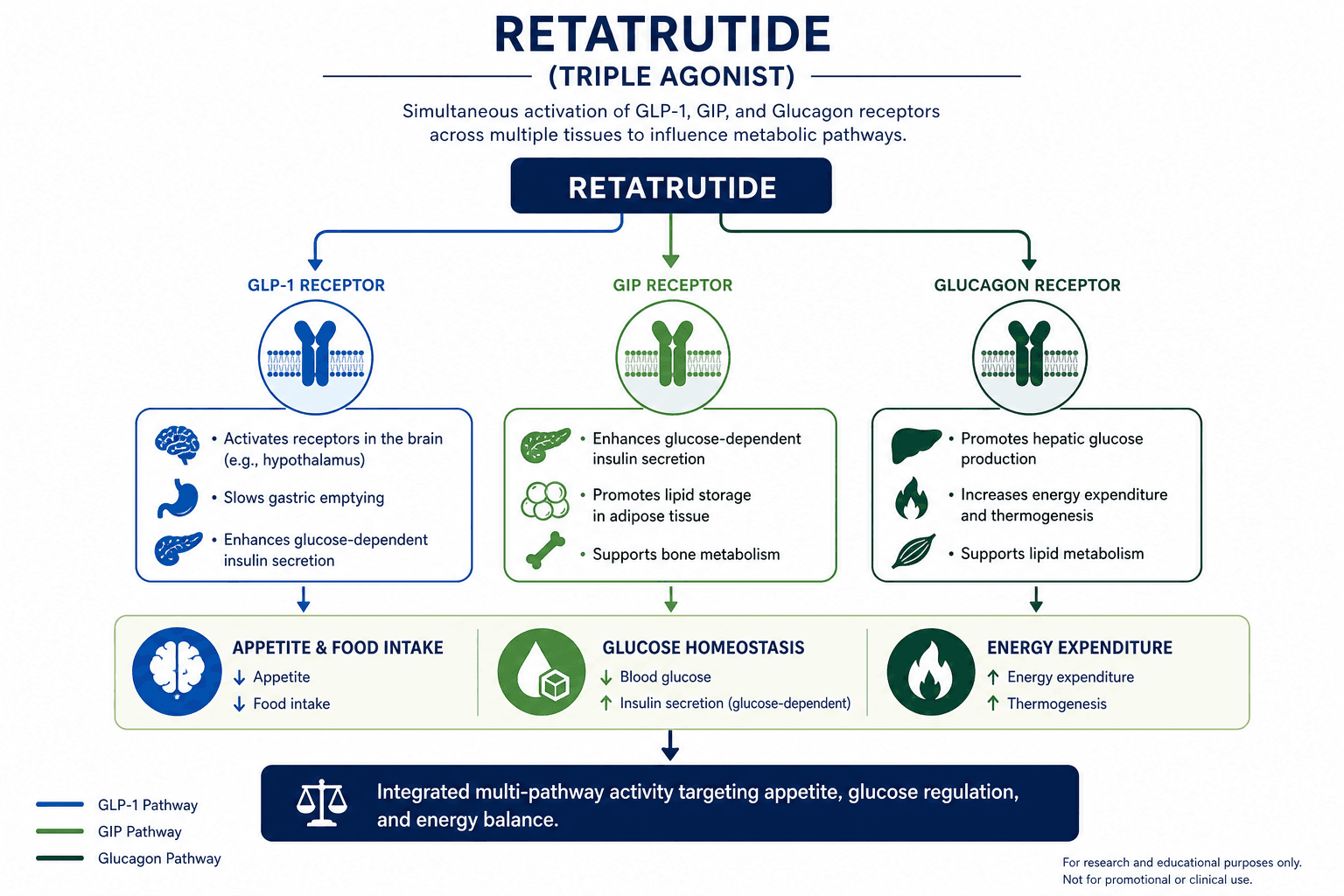
Retatrutide (also known as LY3437943, and commonly abbreviated as Reta) is a synthetic triple hormone receptor agonist peptide that simultaneously targets three incretin-related receptors: GLP-1 (glucagon-like peptide-1), GIP (glucose-dependent insulinotropic polypeptide), and the glucagon receptor. Unlike Semaglutide, which acts on GLP-1 receptors alone, or Tirzepatide, which targets GLP-1 and GIP, Retatrutide represents the next generation of incretin-based research compounds by adding glucagon receptor agonism to the dual-agonist framework.
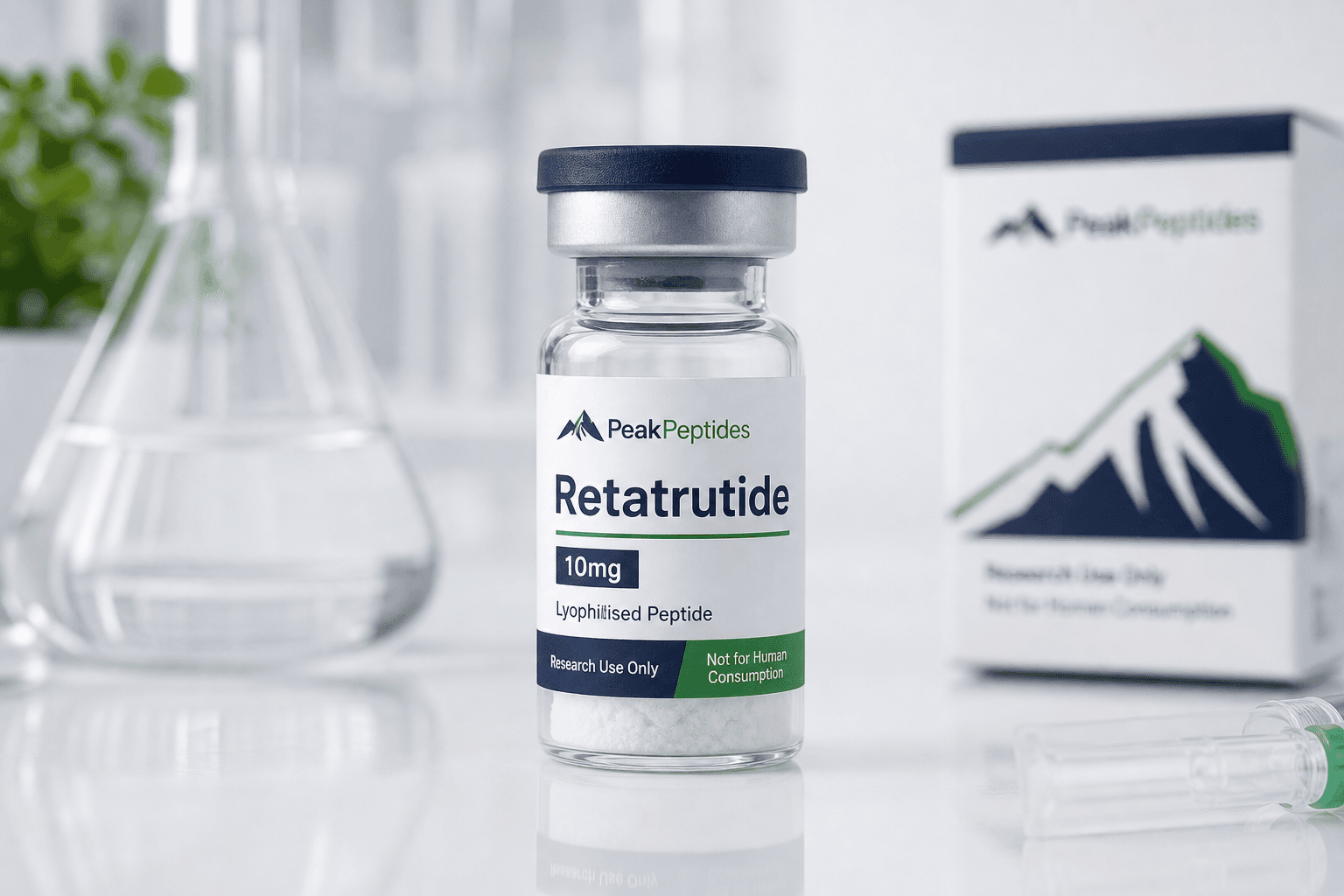
Retatrutide peptide is supplied as a lyophilised powder for laboratory research use only. It is one of the most discussed compounds in contemporary metabolic pathway research, with Phase 2 clinical trial data generating significant interest in its unique triple-agonist mechanism and dose-dependent effects on body composition parameters in research models.


Mechanism
Retatrutide's triple-agonist profile activates three distinct but complementary metabolic pathways. GLP-1 receptor activation modulates appetite signalling through hypothalamic pathways and improves glucose-dependent insulin secretion. GIP receptor activation adds complementary effects on insulin sensitivity and adipose tissue metabolism. Glucagon receptor activation — the key differentiator from dual agonists — increases resting energy expenditure through thermogenesis and promotes hepatic fatty acid oxidation.
Research reference
The following dosage ranges are drawn from published Phase 2 clinical trial data and preclinical research literature. These figures are provided for research reference only and do not constitute dosing recommendations. Retatrutide is sold strictly for laboratory research use.
| Protocol tier | Published research detail |
|---|---|
| Phase 2 trial range | 1 mg to 12 mg administered subcutaneously once weekly in published clinical research |
| Low-dose research tier | 1–2 mg weekly — initial receptor activation studies, tolerability profiling |
| Mid-dose research tier | 4–8 mg weekly — dose-response metabolic endpoint studies |
| High-dose research tier | 8–12 mg weekly — maximum published trial dose, advanced metabolic modelling |
| Titration approach | Published protocols typically escalate dose every 4 weeks to manage receptor adaptation |
| Available vial sizes | 5 mg and 10 mg lyophilised research vials — select based on your laboratory protocol requirements |
Research use only: FOR LABORATORY RESEARCH USE ONLY. Not for human consumption, injection, or therapeutic use. All products are sold strictly as research chemicals. By purchasing, you confirm you are 18+ and agree to use products solely for legitimate research purposes.
Safety research
Side effect profiles documented in published Retatrutide research are consistent with the incretin agonist class, with gastrointestinal effects being the most commonly reported. These findings come from controlled clinical trial settings and preclinical models — not from personal use contexts.
Handling
Retatrutide is supplied as a lyophilised powder and must be reconstituted before use in laboratory protocols. Use bacteriostatic water (0.9% benzyl alcohol) rather than sterile water for multi-dose research vials, as the bacteriostatic agent inhibits microbial growth between uses. Inject the diluent slowly down the inside wall of the vial — do not shake vigorously. Allow the peptide to dissolve gently at room temperature or refrigerate until fully dissolved.
Bacteriostatic water is available from EvoPeak in the Research Supplies category. Store reconstituted Retatrutide at 2–8°C and lyophilised powder at −20°C.
Shop bacteriostatic waterAustralia
Researchers in Australia can source Retatrutide peptide through EvoPeak — a local supplier offering third-party tested research compounds with batch-specific COA documentation and domestic shipping.
Browse Retatrutide variants (5 mg and 10 mg) on the EvoPeak product page
Review the certificate of analysis (COA) for HPLC purity and mass spectrometry identity verification
Select your vial size and add to cart — prices include GST with same-day Australian dispatch
Receive your order with batch-specific quality documentation for laboratory traceability
Quality Standard
Every shopping path leads back to the same core standard: research-use positioning, third-party quality signals, transparent documentation, and careful handling guidance.
Purity and identity checks support confident compound selection for controlled research.
Quality review extends beyond purity so researchers can evaluate handling risk.
COA-first product pages keep quality signals close to every purchase decision.
Local fulfilment keeps delivery predictable for Australian research customers.
Further reading
FAQ
Retatrutide (LY3437943) is a synthetic triple hormone receptor agonist that targets GLP-1, GIP, and glucagon receptors simultaneously. It is supplied as a lyophilised research peptide and is studied for its effects on metabolic pathways including appetite regulation, glucose homeostasis, and energy expenditure.
Tirzepatide is a dual GIP/GLP-1 receptor agonist. Retatrutide adds a third receptor target — the glucagon receptor — making it a triple agonist. The glucagon component is associated with increased energy expenditure through thermogenesis, which dual agonists do not address to the same degree in published research.
Published Phase 2 trial data used weekly subcutaneous doses ranging from 1 mg to 12 mg, with dose escalation every four weeks. Available research vials from EvoPeak are 5 mg and 10 mg. All dosage information is for research reference only.
Published research reports gastrointestinal effects (nausea, vomiting, diarrhoea) as the most common, particularly during dose initiation. Injection site reactions, appetite suppression, and modest heart rate increases have also been documented in trial data. Severity is generally mild to moderate and dose-dependent.
Reta is a common abbreviation for Retatrutide in research communities. Reta peptide refers to the same triple agonist compound (LY3437943) targeting GLP-1, GIP, and glucagon receptors.
Reconstitute lyophilised Retatrutide with bacteriostatic water. Inject diluent slowly down the vial wall without shaking. Store reconstituted peptide at 2–8°C and unused lyophilised powder at −20°C. Bacteriostatic water is available from EvoPeak.
Yes. EvoPeak supplies research-grade Retatrutide peptide to Australian researchers with HPLC/MS verification, batch-specific COA documentation, and domestic shipping. Products are for laboratory research use only.
Order directly from the EvoPeak shop page. Select your preferred vial size (5 mg or 10 mg), review the COA, and checkout with local Australian fulfilment. Same-day dispatch is available for orders placed before the daily cutoff.
No. Semaglutide is a single GLP-1 agonist. Tirzepatide is a dual GIP/GLP-1 agonist. Retatrutide is a triple agonist adding glucagon receptor activation. Each represents a distinct generation of incretin research compounds with different receptor target profiles.
Every batch undergoes HPLC purity analysis (targeting >99%), mass spectrometry identity verification, and endotoxin screening (LAL test). Batch-specific certificates of analysis are available for download on the product page.
Related compounds
Third-party HPLC/MS tested with batch-specific COA documentation. Shipped from Australia for laboratory research use only.